

Kinshasa, October 12th, 2025 (CPA).-Already 36 years in the afterlife, musician François Luambo from the Democratic Republic of Congo, known by the pseudonym Franco De mi amor, is being commemorated this Sunday around the world as an icon who revolutionized guitar playing in Congolese music.
Several fundamental elements of Franco Luambo Makiadi’s legacy make him a central and founding figure of modern Congolese music, as he shaped and popularized Congolese rumba, structuring it musically and enriching it with long, rhythmic compositions full of improvisation and narrative depth.
His unique fluid, expressive and technical style, which became a benchmark for solo guitar, influenced generations of artists across Africa. At the head of TP OK Jazz (Tout Puissant Orchestra Kinshasa), Franco brought together the greatest talents of his time and built a stable, productive orchestra that dominated the music scene for more than three decades.
As a committed musician, this festive artist also sang about social realities, customs, injustices and politics, with lyrics that were sometimes satirical, denunciatory or wise. In this month, which marks the 36th anniversary of his death, many music lovers have expressed the opinion that Franco built a Congolese musical bridge between tradition and modernity, preserving the African essence in his works while integrating modern structures. Franco’s work remains a cultural treasure today, studied, sampled and covered by numerous artists with an impact that has transcended the borders of the DRC, making him a pan-African legend. Through his muses, he left behind a rich, conscious, technically powerful music, deeply rooted in the Congolese soul, of which he is not only an artistic monument, but also a transmitter of memory and culture. ‘A colossus of modern Congolese music, François Luambo left his mark on the second great upheaval in the history of this music, to which his name is inextricably linked,’ wrote Nimy Nzonga in his Dictionnaire des immortels de la musique congolaise moderne (Dictionary of the Immortals of Modern Congolese Music). The author describes Franco as: ‘a moralistic singer, sociologist, provocateur, humorist, activist, non-conformist lyricist, in short, a singer with multidimensional thematic and musical potential’.
It should also be noted that Franco stood out from his contemporaries thanks to his musical heritage, which made him the most prolific composer and a central and founding figure of modern Congolese music. The artist was born on 6 July 1938 in Sona-bata in the province of Central Kongo, to Tetela father Joseph Emongo and Kongo mother Hélène Mbonga Makiesse.
His death on October 12th, 1989 at the clinics of the Catholic University of Louvain Mont-Godinne in Belgium remains, for music lovers, an event that made him an icon, even beyond death. This Sunday, October 12th, marks 36 years since he passed from this life to another.
Master of a Congolese rumba school
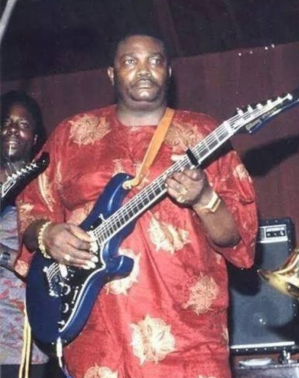
Franco fell into the musical pot at a very young age. It was at the age of 14, after dropping out of school, that he joined the group Watam before founding his own orchestra a few years later, OK Jazz, which became a second school of Congolese rumba after Joseph Kabasele’s African in Jazz. Within his orchestra, Franco was able to bring together the great talents of his time, building a stable, productive orchestra that dominated the music scene for more than three decades. He helped nurture the talents of artists such as Sam Mangwana, Vicky Longomba, Madilu System and Josky Kiambukuta. According to writer Samuel Malonga: « Drawing on the traditional repertoire of his cultural space, the child of Nsona-Mbata released more than twenty songs in Kikongo between 1958 and 1989. They include a mixture of dedications, fables, diatribes, humour, denunciations of witchcraft and customs. With a few exceptions, the village is the setting for the stories of customs that the artist tells. » Kimpa Kinsanga Mene (the mystery, released in 1983 by Éditions Populaires). “The noun kimpa has several meanings in Kikongo. Depending on the context in which it is used, it can mean game, legend, riddle, mystery, a person’s difficult character, or strategy. In this song, Luambo talks about a mysterious event, a kind of demonic game that is suspended in the sky and is nothing less than witchcraft. The moral of the story is: don’t be afraid to speak up to defend the common good, » he explained. Samuel Malonga cited other classics such as: Yimbi, ya Mbala, Mbongo Zi ya Voni (the money of the elder Voni), Ma Nkewa, Lombola, Mantale, among many others.
François Luambo, who died in Namur, Belgium, on 12 October 1989 at the age of 51, is now entitled to well-deserved tributes. He remains the most prolific composer in the Congolese musical microcosm. ACP/