

Kinshasa, July 10th, 2025 (CPA) – The immunity of Congolese public companies transformed into commercial companies in the Ohada era was addressed by a university professor during the 57th anniversary of National Bar Association Day held in the commune of Gombe (north of Kinshasa), capital of the Democratic Republic of Congo. ‘I am going to talk about an issue that concerns lawyers as well as the scientific community. It is the issue of the immunity of Congolese public enterprises transformed into commercial companies during the OHADA era,’ said Jean Michel Kumbu, professor at the University of Kinshasa.
“He indicated that he would address this topic in six points. The first point will be a review of the law of January 6th, 1968 on general provisions applicable to public enterprises. The second point will review the framework for the reform of public enterprises, followed by immunities under international law, immunities under OHADA community law, immunities under Congolese law, and finally the reform on immunity from enforcement in the OHADA area, » he continued. Furthermore, the law of July 7th, 2008 on general provisions relating to the transformation of public enterprises states that current enterprises will be transformed either into commercial companies or into public institutions or services, or will simply be dissolved in order to comply with Ohada law, added Jean-Michel Kumbu.
Immunity in international law
The purpose of immunity, he insisted, is to prevent a State from being judged in a dispute with a private individual by the courts of another country, thus affirming that immunity is based on public international law with a view to respecting the sovereignty of States and the idea of international courtesy. ‘Immunity is therefore a privilege granted to subjects of international law or to certain persons who request it, allowing them to escape the jurisdiction of the normally competent court or enforcement measures by the authorities of the territorial State,’ he said, adding that this means that there is immunity from jurisdiction and immunity from enforcement. In immunity from jurisdiction, one state cannot judge another state, while in immunity from enforcement; the assets of a state cannot be seized.
‘I would like to point out that when the state acts as a sovereign, it is perfectly normal not to interfere. But if the state acts as a businessman, that already poses a problem,’ added Professor Jean-Michel Kumbu. According to Professor Kumbu, those eligible to claim the benefits of immunity are sovereign foreign states and emanations of foreign states when they participate in an activity of sovereignty. « There is a ruling by the Court of Cassation, Chamber X, dated June 20th, 2003, X v. Saudi School of Paris” This is what was said: “It is understood that foreign states and organizations enjoy immunity from jurisdiction insofar as the act giving rise to the dispute participates, by its nature and purpose, in the exercise of the sovereignty of those states and does not constitute an act of management. This is what is known as Jure Impei”. So the state is sovereign and the consequence is that it cannot be sued, added the university professor.
Immunity under OHADA law
Furthermore, the creation of OHADA in 1993 was a response to the legal and judicial uncertainty that prevailed in the states of the zone, he said, arguing that in order to achieve legal certainty, member states decided to unify business law by adopting uniform acts intended to contain simple, modern rules adapted to the economic situation of those states. To this end, debt recovery and enforcement measures were included among the subjects covered by business law, before the uniform act on the organization of simplified debt recovery and enforcement procedures was adopted. He also noted that the DRC had not yet acceded to OHADA at that time. For Professor Kumbu, the uniform act should be recognized for advances such as: the listing of persons benefiting from immunity from enforcement, namely the State, legal persons governed by public law and public institutions, adding that the legislator of the reform of October 18th, 2023, drawing on the lessons of the past, had adopted a new approach consisting of expressly listing those entitled to immunity from enforcement.
The use of technological tools encouraged for the management of law firms
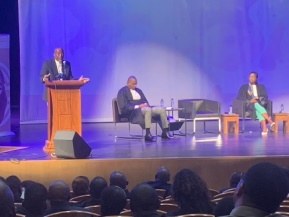
Attorney Kodjo Ndukuma, during his speech
In addition, the use of technological tools in the management of law firms was encouraged by a lawyer at the Gombe Bar on the same day. « Digitalization is a necessity. It is essential for improving the efficiency, profitability and competitiveness of a law firm. This naturally involves adopting new information technologies, improving client relations and strictly complying with regulations to avoid any abuse, » said Mr Kodjo Ndukuma in his presentation entitled Digitalization of law firm management.
During the day, several topics were discussed, including litigation related to public procurement, with a particular focus on the contribution of lawyers in these proceedings. On this subject, Christian Kalume, an expert at the Public Procurement Regulatory Authority (ARMP), explained the conditions for using the private treaty procedure, specifying that this is an exceptional procedure, authorized only in the absence of a call for tenders, after approval by the Directorate General for Public Procurement Control (DGCMP). « Mutually agreed contracts can only be used when the conditions set out in Articles 41 to 43 of the Public Procurement Law are met. The procurement unit must submit a request to the DGCMP for special authorisation. The DGCMP then assesses whether the conditions are met. If not, it rejects the request and requires that the contract be put out to tender, » Christian Kalume explained.
Call for reform of fee structures
For his part, Jean-Claude Mbaki, President of the Gombe Bar Association, speaking on the topic of ‘Fee Practices,’ denounced the low fees currently charged by Congolese lawyers, which he deemed unsuitable for certain sectors such as mining. ‘The DRC is a country with a high level of mining activity, with often complex disputes. However, the majority of lawyers still adopt a flat-rate or subscription-based fee structure, which does not correspond to the reality on the ground,’ he said, arguing that this fee structure impoverishes Congolese lawyers. He lamented the fact that current regulations only provide for the taxation of fees for court appearances, excluding other important aspects of the profession. In his view, several factors should be taken into account when setting fees, including the complexity of the case, the competence of the lawyer and the seniority of those involved in the team. ‘Every lawyer must learn to know themselves, assess their skills and know how to sell themselves. Working as a team also makes it possible to adjust fees according to seniority: senior, medium or junior,’ he advised, while insisting on the need to act with honesty and professionalism. He added: ‘If you have worked three hours, don’t say you have worked ten. Transparency and ethics must always guide the practice.’
Calling for the restoration of normal functioning of local courts in Bas-Uélé
Mr Patrick Lebo, President of the Bas-Uélé Bar Association.
In addition, Mr Patrick Lebo, President of the Bas-Uélé Bar Association in the north-east of the Democratic Republic of Congo, called for the restoration of normal functioning of the courts in that province. ‘Several courts in the jurisdiction are suffering from chronic dysfunction, mainly due to the prolonged absence of certain judges and prosecutors. This situation seriously compromises access to justice for litigants, particularly those in rural and isolated areas,’ said Mr Patrick Lebo, President of the Bas-Uelé Bar Association. He indicated that in light of this alarming situation, the Bar Council has denounced the paralysis of lawyers’ work in this province due to the fact that several of them are forced to work outside the jurisdiction to practice their profession, including some members of the Bar Council. ‘We are making a solemn appeal to the President of the Republic, the Prime Minister, the President of the High Council of the Judiciary, the Governor of Bas-Uélé and all the competent authorities to take urgent measures to restore the effective presence of magistrates in the courts of the interior of the country,’ insisted Mr. Lebo. According to him, the prolonged absence of magistrates in the provinces constitutes a major obstacle to the constitutional mission of the judiciary and undermines citizens’ rights to a fair trial and legal certainty.
On this Bar Day, he concluded, the Bas-Uélé Bar Council reaffirmed its commitment to working for accessible, fair and independent justice in the public interest. It should be noted that the DRC celebrates Bar Day every July 10th, commemorating the anniversary of the establishment of the Congolese Bar. This day is an opportunity for reflection and professional exchange within the country’s courts. The institution of the legal profession in Congo dates back to the Independent State of Congo in 1885, through the appointment of representatives. The first official bar associations were established by decree on November 7th, 1930.