

Kinshasa, February 26th, 2026 (CPA). – Government spokesperson Patrick Muyaya firmly reiterated on Wednesday in Ottawa the imperative not to attribute crimes committed by the M23-AFC, described as auxiliaries of Rwanda, to the Banyamulenge community, during a public conference on the security situation in eastern Democratic Republic of the Congo.
“M23-AFC does not represent the Banyamulenge community. Therefore, the crimes committed by this movement cannot be attributed to that community,” he stated during the conference.
According to the Minister, the Banyamulenge are in fact the first victims of stigmatization orchestrated by Rwanda. He illustrated the DRC’s ethnic diversity by recalling that the country shares nine borders and is home to more than 450 ethnic groups living in mutual tolerance. “Whatever the issue, a head of state of a neighboring country cannot come and commit massacres, use women’s bodies as weapons, under the pretext of protecting a community,” the Congolese government spokesperson emphasized. On diplomatic progress and internal reforms, Mr. Muyaya pointed to what he described as significant diplomatic advances. “For the first time in 30 years, Rwanda has acknowledged its illicit exploitation of minerals in the DRC. We have said there will be no ‘mixage,’ as such operations have weakened our army. We are now engaged in a clean-up process that will allow us to rebuild our armed forces,” he said.
“The Rwanda issue is resolved. It may take two, three or six months more, but diplomatically we have an agreement with the U.S. government. Once the strategic partnership championed by President Donald Trump, accompanied by a security memorandum, is finalized, it will lay the foundation for the return of peace,” he assured, while stressing the distinction between the Rwandan regime and the Rwandan people. “We must clearly distinguish between what pertains to the Rwandan regime and what pertains to the Rwandan people,” he specified.
Fundamental Differences Between the DRC and Rwanda
According to Mr. Muyaya, the fundamental difference between the two countries lies in governance: Rwanda is, in his view, a despotic state, whereas Congo is a democratic country. “In Rwanda, no citizen can relay what I am saying without risking arrest,” he claimed. “We Congolese sometimes relay Rwandan propaganda. Rwanda governs through crime: if you dare to denounce, you die. Their disinformation becomes our information. In Uvira, for example, the pretext was to protect a community. They mobilized vulnerable populations who abandoned their fields and children left school to serve their cause, expecting subsequent massacres. Did that happen? No, because we understood that we must not provide pretexts,” he stressed.
Government Measures and the FDLR Issue
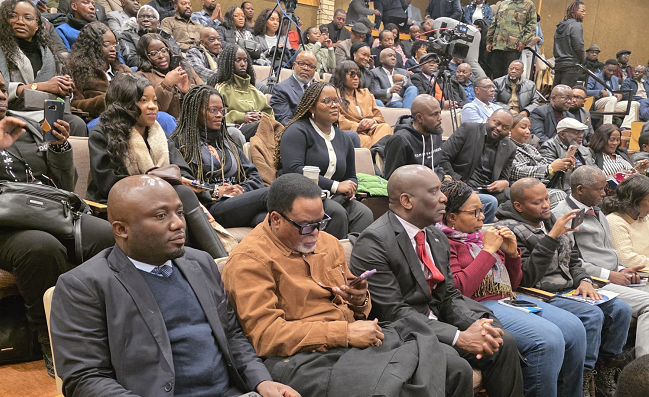
Participants at the Ottawa conference
According to Minister Muyaya, the Congolese government is acting on all fronts—economic, humanitarian, diplomatic and judicial. “Without justice, there can be no peace,” he maintained. Regarding the Democratic Forces for the Liberation of Rwanda (FDLR), he stated that they are refugees who must return to Rwanda and do not constitute a security threat to that country. “We have committed to addressing this issue on our territory, but we cannot do so sustainably as long as Rwandan troops occupy our soil,” he explained. “Let us not forget that in 1997, it was a Rwandan, James Kabarebe—now sanctioned by the United States—who headed the Armed Forces of the DRC. He is the architect of all these wars. The Congolese Rally for Democracy (RCD) occupied Kivu for three years, and the FDLR were already there. Today, Rwanda invokes genocidal ideology to capitalize on the international community’s sense of guilt,” he concluded.