

Kinshasa, April 26 2026 (CPA). – The Government of the Democratic Republic of the Congo has been instructed by the Head of State to introduce, within 30 days, obligations regarding the repatriation of export revenues, according to the minutes of the 87th Council of Ministers, read out on Friday on national television. “Under the coordination of the Prime Minister, he has instructed the Deputy Prime Minister and Minister in charge of Transport, the Deputy Prime Minister and Minister in charge of the National Economy, the Deputy Prime Minister and Minister in charge of the Budget, as well as the Ministers in charge of Finance, Foreign Trade, Mines and the Portfolio, the General Inspection of Finance and Gecamines, with the assistance of his office, to implement the following guidelines: “to launch, within 30 days, a comprehensive and detailed audit focusing, on the one hand, on compliance with obligations regarding the repatriation of export revenues and, on the other hand, on the production of a report on the governance of joint ventures and state-owned mining assets,” has declared Patrick Muyaya, Minister in charge of Communication and the Media. This audit, the government spokesperson has explained, will need to identify any breaches, assess lost revenue and propose remedial measures. He has specified that the President of the Republic has reminded that he had already emphasised the need for “systematic control of the state’s mining assets, as well as the necessity of clarifying its effective representation in joint ventures; the prevailing lack of transparency hinders the maximum mobilisation of revenue and compromises our sovereignty over our natural resources”. Furthermore, he has observed that the failure to repatriate a portion of mining foreign exchange, combined with capital flight via fraudulent imports, remains a major vulnerability.
Exports on the rise: over 3.4 million tonnes of copper achieved
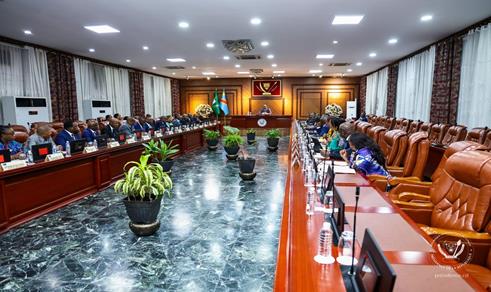
In this regard, the Head of State has welcomed the achievements made in recent years in this sector, particularly in terms of production, with 3,100,234 tonnes of copper and nearly 220,000 tonnes of cobalt, thanks to the Government’s efforts. He has nevertheless lamented a relaxation in the control of the supply chain. “Significant efforts to strengthen governance in this strategic sector have enabled our country to reach historic production levels, with 3,100,234 tonnes of copper and approximately 220,000 tonnes of cobalt exported. In 2024 and 2025, exports continued to rise, reaching 3,403,006 tonnes of copper,” has explained Patrick Muyaya, government spokesperson. “If the problem does not lie in production, it lies in the weakness of the revenue collection chain, from export to public revenue collection,” has specified Felix Tshisekedi, as quoted by Minister Muyaya. The minister has reported that the Head of State is determined to work towards enabling public finances to take full advantage of the strong performance of mining exports and for foreign exchange reserves to consolidate monetary sovereignty, by being firm, realistic, transparent and technically feasible. In this same context, the Government has also been instructed to complete the mandatory interconnection between all administrations and services involved in the mining chain, notably the Office for the Management of Multimodal Freight (Ogefrem), the Congolese Control Office (OCC), the General Direction of Customs and Excise (DGDA), the Central Bank of Congo (BCC) and the relevant commercial banks. “No export or import operation shall henceforth escape an integrated traceability chain enabling the tracking of a single flow from logistics manifests through to the payment of duties, the repatriation of foreign exchange and the actual collection of public revenue,” has insisted President Tshisekedi, before clarifying that this directive follows on from his instructions issued by the Council of Ministers on November 19th, 2021, and May 30th, 2025. The results of initial deliberations on this subject must be presented by June 15th at the latest.