

Kinshasa, April 28th, 2026 (CPA).– The Prime Minister has described, on Tuesday, education as a condition for sovereignty and economic transformation, during the launching in Kinshasa, Democratic Republic of the Congo, of the high-level political segment dedicated to the sustainable financing of education. “Education is not merely a social priority; it is a condition for sovereignty, stability and economic transformation,” has declared Judith Suminwa, Head of Government. She has emphasised, in this regard, in her address, on the urgency of collective mobilisation around the issue of funding.
“How to sustainably finance an inclusive, high-quality education system?” she has asked, highlighting that the challenge is not limited to the volume of resources, but also concerns their effectiveness, their alignment and their prioritisation. The Prime Minister has explained that the Government intends to structure its action around three main priorities: ensuring the sustainability of reforms, particularly free education; investing more strategically by strengthening the vocational training, the research and innovation ; and finally, to mobilise more resources by involving the private sector and developing innovative financing mechanisms.
The progress made on free education praised
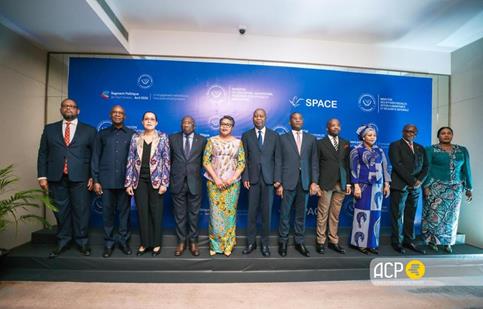
Group photo of the Prime Minister and officials who have taken part in the event
For her part, the Minister of State, Raissa Malu, has praised the progress made towards free education whilst acknowledging the pressures it has placed on the education system, notably a structural funding shortfall, a fragmentation of resources and difficulties generalising pilot initiatives at a national level. For her, a paradigm change is essential: “Funding education can no longer be understood solely as an expense to be covered. It is an investment to be managed. This involves making strategic choices, aligning the actions of the various stakeholders and establishing a culture of measurable results.” This strategic meeting forms part of the completion review of the Sectorial Strategy for Education and Training (SSEF 2016–2025), organised by the Minister of State in charge of National Education and New Citizenship.
The work of this policy segment will focus on four priorities: consolidating free education and considering its gradual extension; improving the efficiency and accountability of funding; strengthening vocational training and literacy; and providing greater support for research, innovation and scientific skills. Through these discussions, the Congolese authorities aim to move beyond the diagnostic phase and take structural decisions. The future Interim Sectorial Strategy for Education and Training 2026–2030 will need to combine ambition with realism, with clear priorities, aligned funding and tangible results