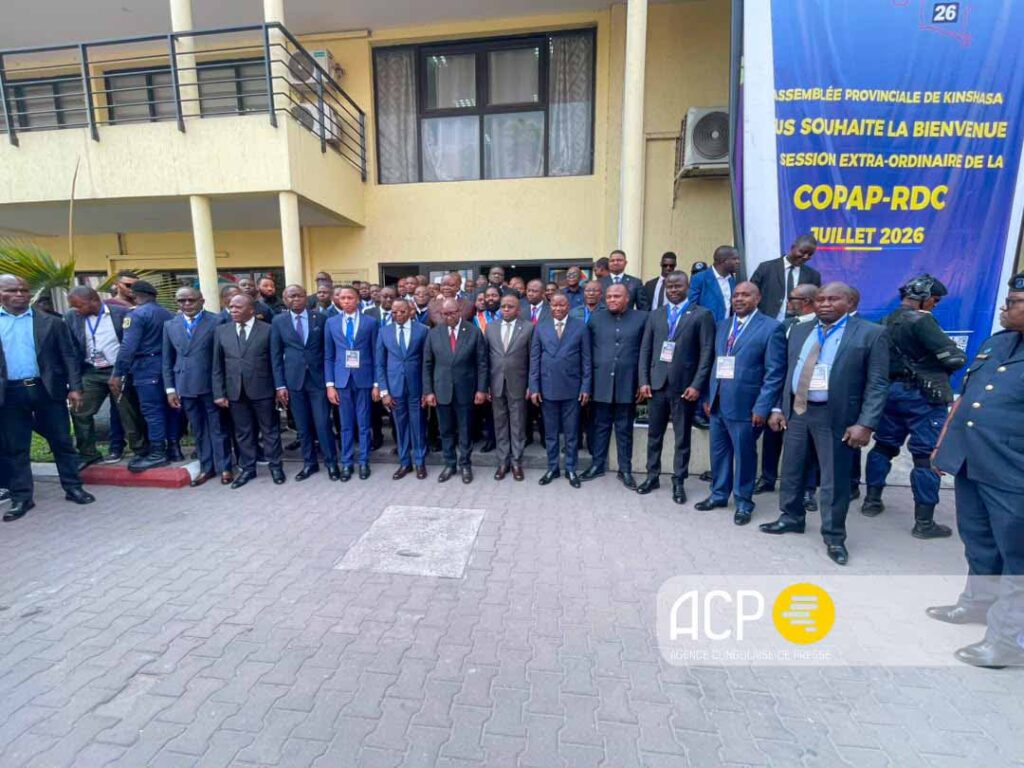

Kinshasa, July 6th, 2026 (CPA). – The Conference of Presidents of Provincial Assemblies of the Democratic Republic of Congo (COPAP-RDC) serves as a permanent framework for consultation, institutional dialogue and the exchange of experiences, its president said on Monday at the opening of the conference held at the Kinshasa Provincial Assembly (APK).
« The Conference of Presidents of Provincial Assemblies is a permanent platform for consultation, institutional dialogue and the sharing of experiences among the leadership of our provincial assemblies. It aims to strengthen provincial governance, institutional cohesion, the stability of our provinces and their harmonious development. Our ambition is to make provincial assemblies true pillars of local democracy, capable of effectively fulfilling their legislative, budgetary and oversight responsibilities over provincial executive authorities, » said Papy Mantezolo, President of COPAP-DRC and Speaker of the Kongo Central Provincial Assembly. According to the COPAP-DRC President, the meeting is intended to provide provincial assemblies with a forum for discussing reforms aimed at strengthening governance, decentralization and institutional stability. « The work of the Conference of Presidents of Provincial Assemblies of the Democratic Republic of Congo will focus, among other issues, on proposals for constitutional reforms, supporting public awareness of future reforms, and the adoption of a social charter for the country’s 780 provincial lawmakers, » he said. He stressed that the conference seeks to strengthen provincial assemblies so they can effectively carry out their legislative, budgetary and oversight mandates.
« During these four days of intensive deliberations, this extraordinary session will focus on three key issues, including constitutional reforms. We will formulate concrete recommendations and proposals to redefine the role of provincial assemblies and strengthen their powers within the country’s evolving institutional framework, » he added.
The participants will also consider mechanisms to promote the political stability of provincial institutions and harmonize their relations with the central government. « As institutions closest to the people, we have the responsibility to prepare public opinion to understand and embrace this democratic instrument of sovereignty, which concerns all matters of national interest, » he concluded.
President’s Efforts to Restore Peace Praised