

Kinshasa, November 1st, 2026 (CPA). – The Government of the Democratic Republic of the Congo (DRC) has reaffirmed on Saturday in Kalemie, the chief town of Tanganyika, its commitment to the effective implementation of the Women, Peace and Security Agenda, to mark the 26th anniversary of United Nations Security Council Resolution 1325. “I reaffirm DRC Government’s commitment to continue its efforts towards the effective implementation of the Women, Peace and Security Agenda,” Micheline Ombae, Minister in charge of Gender, Family and Children, has declared. “As we celebrate the twenty-sixth anniversary of Resolution 1325, we renew our promise to Congolese women: never to leave them on the side-lines of peace processes, never to trivialise the violence they endure, and never to forgo their full participation in the building of our nation,” she has added. She has specified that the Congolese government’s ambition must be clear: “to make every woman an agent of peace, a builder of social cohesion and a full participant in decisions that shape our country’s future”. She has indicated that a peace negotiated without women is an incomplete peace. In her view, reconstruction that excludes women is fragile. And development that does not value women cannot be truly sustainable.
A rising female representation
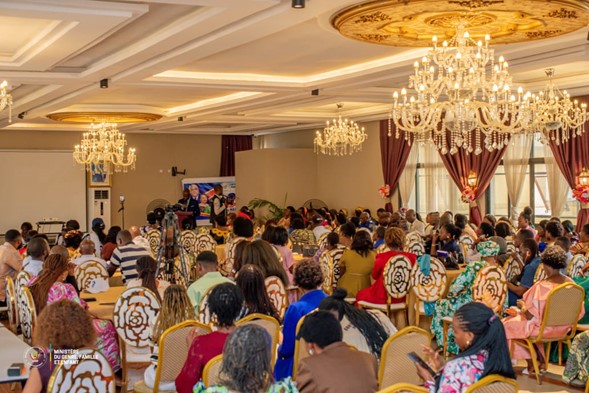
One of the most significant achievements concerns political participation. According to the Minister, the representation of women within the Government has risen from 15% to 34%, to 25% in the judiciary, 12% within the police force and 32% in peace initiatives. “Our country has reached a historic milestone with the appointment, for the first time since 2024, of a woman as Prime Minister,” she has reminded. As regards women’s representation in the National Assembly, they account for 13.6%, in the Senate 17% and in local councils 19%. “On the ground, this momentum is reflected in the capacity-building of thousands of women in mediation, the establishment of local security committees and early warning mechanisms, and the recruitment of more than 1,500 young women into the FARDC, with a target of 20,000 female military personnel,” she has added. At provincial level, 7 provinces, including Tanganyika, have already drawn up their Provincial Action Plans for Resolution 1325. The Minister has encouraged the other provinces to join this initiative by 2027. According to DRC’s Minister in charge of gender issues, these advances, whilst not yet perfect, demonstrate that women’s participation in governance and decision-making mechanisms is not a favour granted to them, but a fundamental right and an essential condition for democracy, stability and lasting peace. She has also highlighted another significant achievement: the mobilisation of Congolese women, which has led to the drafting of a single set of terms of reference setting out their main concerns and demands, with a view to their effective participation in the peace process and the inclusive dialogue currently taking place in the country. She has also commended the efforts made to build the capacity of thousands of women in the areas of mediation, negotiation and peaceful conflict resolution. Resolution 1325 has been adopted on October 31st, 2000, by the UN Security Council. Resolution 1325 is the first resolution to officially recognise that wars affect women differently, and that peace cannot be achieved without them. For DRC, it is a major strategic instrument. That is why, every October 31st, the Ministry in charge of Gender, through the Permanent National Secretariat for Resolution 1325, reviews the progress of its National Action Plan (NAP 1325).