

Kinshasa, June 18th, 2026 (CPA).- The Government of the Democratic Republic of Congo (DRC) has reaffirmed its commitment to building a credible justice system in the digital era, according to a message consulted on Thursday by CPA on the X account of the Ministry in charge of Justice. “Opening the national awareness campaign for judicial stakeholders on the Digital Code, the Minister of State, Minister of Justice and Keeper of the Seals, Guillaume Ngefa, presented the Government’s vision: to build a modern, efficient and credible justice system capable of protecting citizens in all environments, including the digital space,” the message read. According to the same source, Minister Ngefa, alongside the Minister of Digital Economy, Augustin Kibassa, and the Prosecutor General at the Court of Cassation, Firmin Mvonde, emphasized that the rapid expansion of digital technologies requires the justice system to adapt to new forms of crime, including online fraud, privacy violations, identity theft, cyber-attacks, disinformation and the dissemination of illegal content through social media.
“Digital technology creates no exception to the rule of law,” he insisted, recalling that digital platforms are not “lawless spaces.”
He also maintained that the fight against cybercrime must be conducted in strict compliance with the Constitution, the laws of the Republic and the DRC’s international commitments, while safeguarding fundamental freedoms, particularly freedom of expression, the protection of personal data and the rights of the defense. Addressing judges, lawyers, civilian and military prosecutors, as well as other actors within the justice system, Minister of State Ngefa recalled that the Digital Code now constitutes the reference legal framework governing electronic evidence, cyber security and the prosecution of digital offences.
He added that, in order to ensure its harmonized implementation throughout the country, a circular has been issued to courts and prosecutors’ offices specifying the principles that should guide the handling of digital-related cases.
Training judicial actors to meet digital challenges
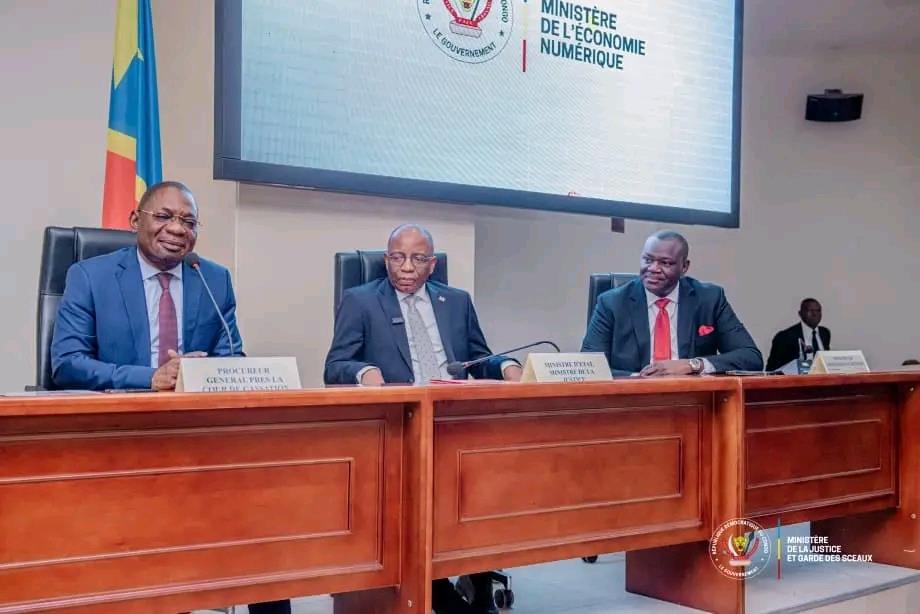
“At a time of digital transformation, the mission of justice remains unchanged: to guarantee rights and freedoms, ensure equality before the law and prosecute offences while respecting procedural safeguards. The judge remains the guardian of individual freedoms, while the public prosecutor safeguards public order under the supervision of the competent courts,” he stated. He further stressed that the Government considers the modernization of the justice system to depend on strengthening the capacities of judges and all justice professionals, noting that digital litigation requires greater expertise in electronic evidence, judicial jurisdiction and international judicial cooperation. According to Minister Ngefa, this ambition is built around five priorities: prevention, awareness-raising, training, capacity building and institutional coordination. “The objective is to equip the DRC with a justice system capable of supporting digital transformation while consolidating the rule of law,” he said. “The modernization of justice is meaningful only if it strengthens legal certainty, facilitates access to justice and guarantees effective protection of fundamental rights,” he warned, concluding that under these conditions, digital technology will become a genuine driver of public trust and a factor in strengthening the rule of law.