

Kinshasa, April 7th, 2026 (CPA) – The national portfolio of priority projects constitutes a dynamic framework providing the State with a pool of structured and bankable projects under public-private partnerships in the Democratic Republic of the Congo, the Deputy Prime Minister in charge of Planning stated on Tuesday in Kinshasa, at the opening of a workshop dedicated to its presentation. “The national portfolio of priority projects offers the State a clear forward-looking vision and a reserve of structured and bankable projects aligned with our sectoral priorities,” said Guylain Nyembo, Deputy Prime Minister in charge of Planning. On this occasion, Minister Nyembo specified that the revised draft law on public-private partnerships (PPP) was designed, in particular, to simplify procedures, secure investments and ensure greater transparency in contract awards. “Public-private partnerships are emerging as an essential strategic lever, enabling the mobilization of additional financing as well as the technological expertise required for the development of our infrastructure and public services,” he said. Mr. Nyembo also pointed out that this portfolio reflects the government’s commitment to addressing persistent challenges, particularly in terms of coordination, project structuring, risk management and the attractiveness of the legal framework. Within this framework, the government has committed to addressing identified shortcomings and integrating international best practices to strengthen the country’s credibility with national and international investors. “It is also about clarifying institutional roles and improving project preparation and selection mechanisms, aligning the legal framework with international standards, and making it a key measure of the government’s economic program supported by the International Monetary Fund’s Resilience and Sustainability Facility, with a deadline for submission to Parliament by the end of June 2026,” he added.
40 priority projects across 12 economic sectors
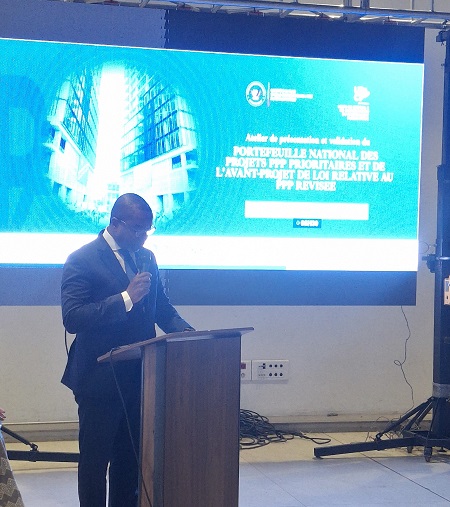
View of the Director General of UC-PPP
For his part, François Ngenyi, Director General of the Public-Private Partnership Advisory and Coordination Unit (UC-PPP), stated that the project portfolio currently includes 40 priority projects spread across 12 sectors, including energy, transport, water and health, some at the feasibility stage and others considered bankable. These identified projects include the implementation of the Mbanza-Ngungu agro-industrial park, the construction and public service delegation of fiber optics infrastructure, the construction of the Brazzaville–Kinshasa rail bridge, the expansion of the Tshopo hydroelectric power plant, and the improvement of electricity supply in Kalemie. Regarding the draft law, the Director General indicated that this legal framework aims to introduce several improvements, notably legal and economic-functional approaches, clearer classification of institutional roles and separation of functions, as well as the explicit integration of environmental and climate requirements. “Today’s work aims to validate these elements, prioritize projects to be promoted in 2026 and formulate the necessary legislative amendments. It also seeks to disseminate the innovations contained in the draft law, collect technical inputs to finalize amendments, validate the mapping of priority PPP projects and ensure their sectoral consistency,” he added. Mr. Ngenyi also commended the leadership of the President of the Republic through the government, as well as the support of various partners, notably the African Development Bank (AfDB), through its financial assistance via the Fragile States Financing Execution Unit (CFEF) and the “CPS”. These two-day technical discussions, from April 7th to 8th, bring together stakeholders from the public and private sectors, civil society and technical partners around three key issues presented by the “CPS” firm, namely the criteria for determining project bankability, modalities of public guarantees, and transparency and arbitration measures to ensure investor and citizen confidence.
At the end of the proceedings, a consensual technical validation report will be produced, including a list of priority amendments to the draft law, as well as a timetable for finalizing and promoting the project portfolio.