

Kinshasa, December 22nd, 2025 (CPA). – On Monday, the government of the Democratic Republic of Congo (DRC) was called upon by the National Human Rights Commission (CNDH) to bring perpetrators of serious violations to justice during a day of reflection on the human rights situation in the east of the country in Kinshasa. ‘Following this reflection, the CNDH is making the following appeals: to the Government of the Republic to strengthen the protection of civilians, guarantee humanitarian access and bring the perpetrators of serious violations to justice,’ said Benoît Mudiayi, communications adviser to this Congolese institution supporting democracy, who read the message from the president, who was unable to attend.
According to the message, the defense and security forces were called upon to strictly respect human rights and international humanitarian law; the international community was called upon to provide increased support to national human rights protection mechanisms and humanitarian assistance; and armed groups were called upon to immediately cease violence against civilian populations. Another recommendation addressed to civil society organizations and the media was to document human rights violations in a responsible and ethical manner. For the CNDH, the situation in eastern DRC can no longer be considered inevitable. It argued that ‘the publication of reports on human rights violations must be a starting point for concrete action focused on protecting victims, restoring human dignity and consolidating the rule of law’.
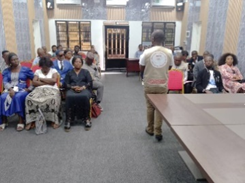
The CNDH’s communications advisor, speaking on behalf of the institution’s president, focused his message on ‘the humanitarian situation in the east of the country and mechanisms related to the protection of human rights.’
He noted that for more than three decades, the provinces of North Kivu, South Kivu and Ituri and other neighboring areas have been facing a multidimensional crisis with dramatic humanitarian consequences. He referred to the investigations, monitoring missions and reports documented by the CNDH, which highlight, in particular, massacres of civilians, summary executions and targeted assassinations; sexual and gender-based violence used as a weapon of war, affecting mainly women and girls, but also men and boys, and even babies.
There have also been massive population displacements, with millions of internally displaced persons living in appalling conditions, without adequate access to water, health care, education and security, and forced recruitment of children.
In addition to the importance of publishing reports on rights violations, CNDH adviser Mudiay discussed the national mechanisms implemented by this citizen institution. These mechanisms include the systematic and ongoing monitoring of human rights violations in areas affected by armed conflict.
He also discussed his institution’s role in coordinating national, African and international mechanisms. This day of reflection featured several highlights, including the first discussion on the security situation in the east of the country; the second on the humanitarian situation in the same part of the country and mechanisms related to the protection of human rights; and the third on the operationalisation of transitional justice in response to the massacre perpetrated in the eastern parts of the DRC. ACP/