

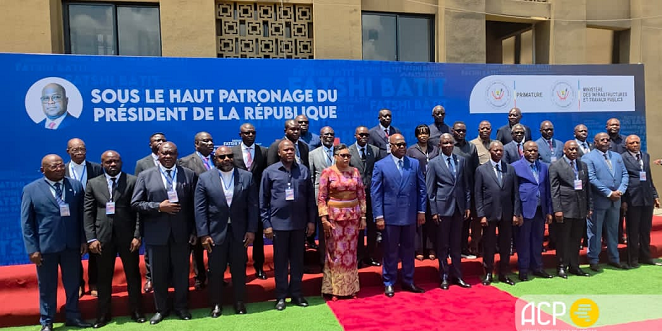
Kinshasa, April 8th, 2026 (CPA).- The President of the Democratic Republic of the Congo has preached the establishment of a new infrastructure management system, based on planning, foresight and sustainability, as opposed to the logic of constant repair, at the opening on Wednesday in Kinshasa of the first national conference dedicated to the sector. “We must move away from a model of constant repair and embrace a genuine system-based culture that plans, sets standards, maintains, anticipates and assesses the life cycle of infrastructure; a system that finally integrates the requirements of climate, innovation, sustainability and competitiveness,” has declared Felix Tshisekedi while opening the conference at the Central African Cultural and Artistic Centre. He has indicated that this approach is essential at a time when the survival of cities demands infrastructure that is resilient to the adverse effects of climate change. “The climate change now compels us to think in terms of resilient infrastructure, capable of withstanding more extreme weather events, more unstable hydrological regimes and increased pressure on land and structures. (…) In the same way, we must make better use of local materials, promote in-depth research, apply and encourage technical innovations suited to our environmental realities, and fully integrate digital tools into the design, monitoring, maintenance and management of our infrastructure,” has argued the Congolese Head of State. To this end, he has listed a number of achievements and on-going infrastructure projects, evidence of his government’s determination to succeed in the challenge of national reconstruction, with the support of its partners. These include, in particular, the rehabilitation of National Road No. 17 (RN17), the country’s main transport artery, and the deep-water port of Banana, envisaged as a key infrastructure for accelerating economic development. Despite major budgetary constraints, President Tshisekedi has said, the Government has undertaken the rehabilitation of several critical sections, as well as the modernisation of airport, port and administrative infrastructure.
There can be no modern infrastructure without reliable and accessible energy
“The fourth axis is the integration of strategic energy infrastructure. There can be no modern infrastructure without reliable and accessible energy; there can be no sustainable competitiveness without a solid digital foundation. That is why the deployment of the fibre-optic networks, the expansion of capacity, and support for decentralised energy solutions, particularly solar power (…) must go hand in hand with our infrastructure policy to transform our regions into areas of opportunity,” has indicated the Congolese President. In this context, he has maintained, every kilometre of infrastructure built must be viewed not only as a service facility, but also as a lever for economic modernisation and social transformation. To continue this momentum of national development, the Head of State has reiterated his call to the various partners for balanced, transparent and mutually beneficial collaboration. “To succeed in this challenge, the involvement of all stakeholders is essential. I call on the private sector, both national and international, to commit more fully to the financing, construction, maintenance and operation of key infrastructure within the framework of a balanced, transparent and mutually beneficial public-private partnership,” has concluded President Tshisekedi.