

Kinshasa, December 22nd, 2025 (CPA). – On Monday, the President of the Democratic Republic of Congo (DRC) launched the construction of a modern city, extending the country’s capital, Kinshasa, to its eastern part, during a ceremony at Cité de Menkao, in the urban-rural commune of Maluku. ‘On this historic day, marked by the laying of the foundation stone for the project to extend the city of Kinshasa towards Maluku, with its industrial city and hospital complex components, I would like to state loud and clear that the ceremony that brings us together today goes far beyond the symbolic framework of a solemn start to the work,’ said Alexis Gisaro, Minister of Urban Planning and Housing, before President Félix Tshisekedi laid the foundation stone.
According to him, this ceremony also constitutes a major political act, a confident strategic decision and, above all, a clear break with decades of uncontrolled urbanization. ‘The stone you are laying today is the foundation of a new Kinshasa that is better organized, better connected, more productive and resolutely focused on the future. With this act, you are sending a clear message: the time for urban improvisation is over, the time for human disorder in cities is over,’ he said. The construction of this new city is a means of preventing demographic change in the capital, which has become a megacity of more than 16 million inhabitants, with the risk, according to some credible projections, of becoming the largest city on the African continent by 2030.
Making Kinshasa a hub of production and innovation
In addition, the Minister in charge of Urban Planning specified that the ‘Kinshasa-Kia Mona’ project also reflects the implementation of the government’s approach to make urban planning a lever for economic development with several development hubs. « Your government’s ambition is to make the Kinshasa expansion project, known as Kinshasa-Kia Mona, an economic and industrial project, designed to transform the outskirts of Kinshasa into a hub of production and innovation, where it will cease to be a city with a single centre and become a network of complementary hubs connected to the rest of the country and regional corridors, » he said.
The Maluku industrial city, the first phase of the project
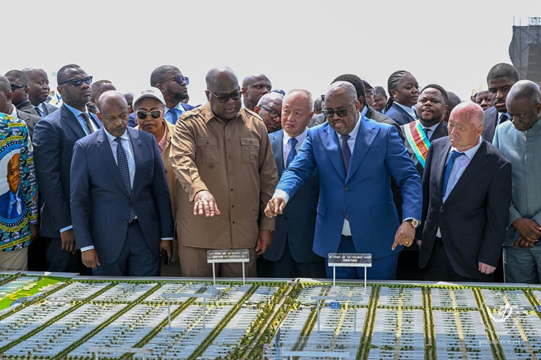
Listing the various components of this modern city, Alexis Gisaro specified that construction will begin with the development of the Maluku industrial city, followed by other infrastructure. ‘The Maluku Industrial City, which is the first phase of this project, covers 75 km² within a planned city of 430 km² where the first production units, processing workshops, logistics warehouses and energy and road infrastructure will be located,’ he said. According to him, these factories will constitute the economic heart of the project, the financial engine and the productive lung that will enable, in a second phase, the construction of the residential area and urban facilities associated with housing, schools, hospitals, markets, green spaces, etc. ‘In this way, industry precedes the city in order to better support it. It is an integrated development approach where economic activity generates the resources necessary for sustainable urbanization,’ concluded Minister Gisaro.
For Mr Daniel Bumba, Governor of the city of Kinshasa, the expansion of the Congolese capital is not just an infrastructure project. According to him, it is a concrete response to traffic congestion, urban saturation, spatial disorder and the challenge of youth employment. ‘It embodies our common desire to build an attractive, balanced and forward-looking capital city,’ he said. Governor Bumba also called for strict compliance with deadlines, quality standards and safety rules. ‘The success of this project is a collective requirement and a duty to present and future generations,’ he stressed. Mr Thierry Katembwe, senior coordinator of the Strategic Committee for the Supervision of the Kinshasa City Extension Project (CSSPEVK), said that ‘this new beginning covers 430 km²’. For him, ‘Kinshasa-Kia mona is a resilient, smart, green and modern city’.
‘This city will finally be the starting point for a major project. This industrial city covers 700,500 hectares, or 75 km²,’ he said. ‘This industrial city will create 225,000 jobs over the next 10 financial years. In its first year, we will need 30,000 jobs. And young people are expected here. New Congolese talent is already on board with us,’ he emphasized. According to Mr. Thierry Katembwe, the 160 factories in the industrial city will be completed by 2026. « Today, we are launching this project, not just to lay the foundation stone, but to lay the groundwork to be able to start this project and ensure that over the next five years, with deliveries each year, the 160 factories in the industrial city will be completed next year. We then have 1,000 hectares of logistics facilities along the river. We have a marina and an urban development area covering around 20,000 hectares. We have an agro-pastoral area covering 8,600 hectares, the green belt, » he explained. ACP/