

New York, March 9th, 2026 (CPA). – Prime Minister Judith Suminwa has accused, on Monday, Rwanda and the M23 of turning the women from the eastern part of the Democratic Republic of Congo into targets of systematic violence, in her address to the United Nations. A frank indictment on the occasion of the International Women’s Day celebrated in New York, in the United States.
‘Since the aggression led by Rwanda and supported by the M23-AFC group, the women and the girls in the affected areas face serious violence, displacements and a humanitarian crisis,’ has declared the Congolese head of government, breaking with measured diplomatic language. On the occasion of the 70th session of the Commission on the Status of Women, themed ‘Rights, Justice and Action,’ and the 30th anniversary of Beijing, the Prime Minister has made this accusation the focus of her speech, forcing the international community to face the human consequences of regional dynamics.
Deep-rooted reforms, a lack of protection
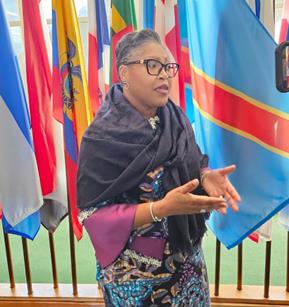
The Prime Minister did not limit her remarks to international condemnations. She has reminded the legal advances made in Kinshasa: the inscription of the principle of equality in Article 14 of the Constitution, the revision of the Family Code in 2016 (abolition of marital authorisation, legal age of marriage set at 18 years) and the law on the conditions for the application of women’s rights and parity. Despite these legislative advances and an increase in female representation, which according to her has risen from 21% in 2021 to 32% in 2024, Judith Suminwa Tuluka has emphasized that these laws remain meaningless as long as women’s safety is not guaranteed.
Women on the front line: specific violence and displacement
‘The conflicts do not affect men and women in the same way,’ the head of government has insisted. She has described a reality made up of sexual assault, mass displacement and deprivation, which have hit in full force the Congolese women in the East of the country. For her, this is not only a humanitarian report, but a phenomenon that demands recognition and targeted response. ‘Invisibility and minimisation must stop,’ she has warned.
Consistency and credibility: the call to international institutions
The presentation has been also an urgent call for diplomatic consistency. ‘Promoting women’s rights requires consistency and credibility,’ has declared Ms Suminwa, claiming that ‘the influence exercised within our decision-making bodies must be fully aligned with the principles that we collectively defend’. She has challenged the assembly: ‘Are we really capable to effectively protect women, to punish violations of their rights and to sustainably redress the injustices they suffer?’
Economic empowerment, fragile hope
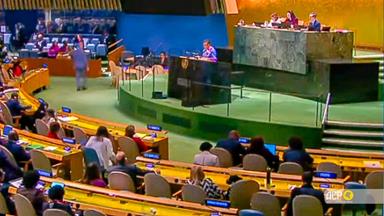
Suminwa Tuluka has highlighted the national efforts to empower women (support for entrepreneurship, Local Development Programme in 145 territories), but has insisted: « Without peace and protection, the economic empowerment will remain theoretical. » Public policies, however ambitious they may be, come up against the reality of violence and displacement, which destroy social and economic gains.
An ultimatum for the 70th Commission
The Prime Minister has requested, in conclusion, that the session be ‘a moment of responsibility and renewal’ and that we stop being satisfied with words. Her message, harsh and non-negotiable, was clear: to name the responsibilities, to punish the perpetrators and to compensate the victims are no longer diplomatic options but imperatives. ‘Let’s turn our commitments into concrete actions,’ she has insisted, ‘so that equality, justice and peace become a reality for all. »
The Prime Minister’s firm stance in New York has transformed the Beijing celebration into political summons: the international community is now faced with a choice between indifference and effective measures to protect women from the East of DRC. ACP/