
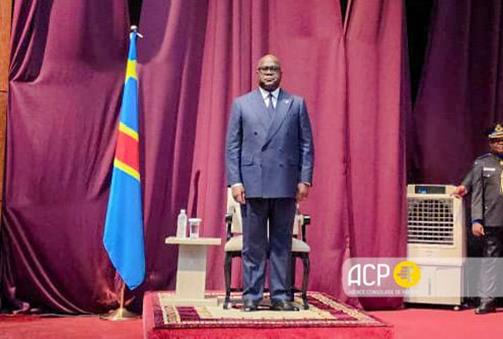
Kinshasa, March 3rd, 2026 (CPA). The work in close collaboration between the Ministries in charge of Finance and Budget has been recommended to promote ‘good budgetary education’ in the Democratic Republic of Congo (DRC), at the opening of the judicial year of the Court of Auditors on Tuesday in Kinshasa, in the presence of the Congolese Head of State. « It follows from the above that the two ministers are collectively accountable to the Congolese people for good budgetary education. This shared responsibility is specifically designed to prevent the recurring irregularities and malfunctions identified by the Court of Auditors in its reports, in particular the unjustified expenditure of funds in favour of certain ministries and institutions, and the chronic under-spending in other sectors, » has declared Jimmy Munganga, First President of the Court, in his presentation entitled: ‘Respect for accountability, a guarantee of sound and responsible financial governance in DRC’. ‘These irregularities are also the abusive use of emergency procedures, the accumulation of budgetary decrees, irregularities in the management of public debt, the failure to take charge of credit and capital expenditure carryovers, and the ineffective supervision of credit movements,’ he has added.
The of the Republic at the opening of the Court of Auditors’ judicial year
For him, a good collaboration between the two ministers requires a clear but complementary division of tasks. « The Minister in charge of the Budget is responsible for preparation, appropriations, budgetary commitments and monitoring authorisations, while his colleague in the Ministry in charge of Finance is responsible for revenue mobilisation, scheduling and cash management, payment of expenditure and accounting. Things must be clear. The budget authorises, the finance department executes, » has maintained the speaker.
De facto management linked to the principle of separation between authorising officer and accounting officer
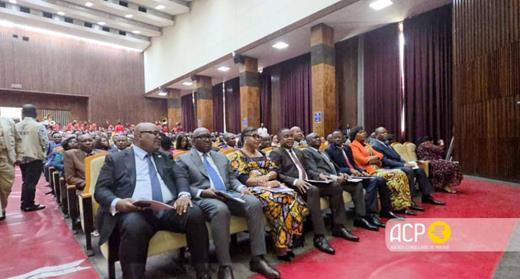
In his speech, Guy Tshipata, Attorney General at the Court of Auditors, has indicated that the concept of de facto management is linked to the principle of separation of the authorising officer and the accounting officer, designed to limit the risk of embezzlement of public funds, corruption, extortion and other forms of anti-values in the management of public finances and assets. The ideal of the rule of law, he has said, ‘requires that every public fund be traced, justified and, where necessary, protected by rigorous sanctions’. According to Law No. 11/011 of July 13th, 2011 on public finances, the authorising officer is the head of an institution, a minister of the central government, a member of the provincial government, a member of the executive college of decentralised territorial entities, the head of the supplementary budget or the person delegated by him, Mr Tshipata has clarified. On the other hand, a public accountant is any agent qualified to execute, in the name and on behalf of the central government, the province, or the decentralised territorial entity, operations relating to revenue and expenditure, the handling of funds and securities held by it, as well as operations relating to public property. The Public accountants are appointed by the central government minister responsible for finance. The latter specifies the powers and matters falling within their remit. The public accountant is not subordinate to the authorising officer and only executes his orders after having thoroughly verified the regularity of the operations.
For Attorney General Tshipata, the separation of the functions of authorising officer and public accountant is based on mutual control, fraud prevention and the specialisation of tasks between the authorising officer and the public accountant.
Submission of the Court of Auditors’ report for the 2024-2025 financial year
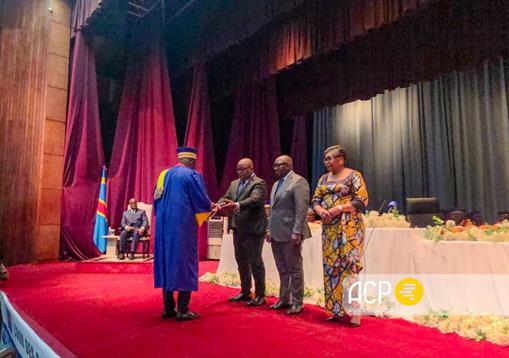
In addition, the Court of Auditors’ report for the 2024-2025 financial year has been presented to the President of the Court during this formal hearing. This report gives an account of the activities carried out by the Court of Auditors. It highlights particularly serious irregularities identified during audits, sets out the main observations made and proposes recommendations aimed at correcting the shortcomings, anomalies and malfunctions observed in the management of public finances and assets. It also outlines the main institutional activities of the Court of Auditors over the last two years, has explained Jimmy Munganga, before presenting it to the Head of State, the presidents of both houses of Parliament and the Prime Minister.