

Kinshasa, October 5th, 2026 (CPA).- The Confederation of African Football (CAF) has portrayed Democratic Republic of the Congo (DRC) national team coach Sébastien Desabre, who has been invited to its Strategic Conference scheduled for October 7 to 9 in Sal, Cape Verde, as the coach who put the Leopards back on the World Cup map 52 years after their first appearance, according to the website of the continental football governing body. “Sébastien Desabre will attend the CAF Strategic Conference in Cape Verde with a wealth of experience, having rebuilt one of Africa’s historic footballing nations and brought the DRC back to the FIFA World Cup after 52 years away. The French coach led the Leopards to the 2026 World Cup finals, only the second World Cup appearance in their history, and into the knockout stage, where they pushed England all the way before losing 2-1 in the Round of 32,” CAF said. According to the source, the French coach’s career particularly resonates with the themes of the CAF Strategic Conference, which will examine why nine of Africa’s ten representatives — a record — progressed beyond the group stage in 2026, and how these lessons can help strengthen African football ahead of the 2030 deadline. “Desabre’s contribution also offers a different perspective from that of several other coaches who were present at the World Cup. Although born in France, he gained most of his high-level coaching experience in Africa, working in Côte d’Ivoire, Cameroon, Tunisia, Angola, Morocco, Egypt and Uganda before taking charge of the DRC.” His experience across different football cultures, leagues and national-team environments has made him one of the continent’s most experienced coaches. “After transforming a DRC team that had been absent from the World Cup since 1974 into a side capable of competing against Portugal, Colombia and England, Desabre brings a testimony that naturally fits into the broader discussions at the Conference on technical development, continuity and long-term planning.” CAF explained that this profile forms part of the same overall approach adopted for coaches such as Bubista and Emerse Faé, linking their personal careers to the lessons African football can draw from their World Cup experiences.
A coaching career built across Africa
Born in Valence, France, Desabre began his coaching career at ES Le Cannet-Rocheville before moving to Africa in 2010 to take charge of ASEC Mimosas in Côte d’Ivoire. That move marked the beginning of a career that would take him through some of the continent’s most competitive football environments. He subsequently coached Coton Sport in Cameroon, winning the national championship and reaching the CAF Champions League semi-finals, before gaining further experience with Espérance Sportive de Tunis, Recreativo do Libolo in Angola, JS Saoura in Algeria and Wydad Athletic Club in Morocco.
He also worked with Ismaily and Pyramids in Egypt, as well as French club Chamois Niortais. His first major position at the helm of a national team came with Uganda, whom he guided to the knockout stage of the 2019 Africa Cup of Nations (AFCON) in Egypt. That experience further strengthened a reputation built on organization, discipline and the ability to make teams competitive in demanding environments. It was in this context, according to the source, that the DRC appointed him in August 2022, launching a project that would eventually return the Leopards to the global stage.
Sébastien Desabre through the maze of the continent
As can be seen, Desabre has truly established himself as a coach deeply familiar with the complexities of the African continent, particularly at national-team level. But before making his mark with national selections, he gained experience at club level. “He then coached Coton Sport in Cameroon, winning the national championship and reaching the semi-finals of the CAF Champions League, before moving on to Espérance Sportive de Tunis, Recreativo do Libolo in Angola, JS Saoura in Algeria and Wydad Athletic Club in Morocco. He also worked with Ismaily and Pyramids in Egypt and had an experience with French club Chamois Niortais.” His first major experience at the helm of a national team came with Uganda, whom he guided to the knockout stage of the Africa Cup of Nations in Egypt in 2019, before being hired by the DRC three years later, in August 2022. This further strengthened his reputation for organization, discipline and the ability to make teams competitive in demanding environments, while launching a project that would eventually return the Leopards to the global stage.
Restoring confidence in the Leopards
One of Desabre’s first major achievements with the DRC came at the 2023 Africa Cup of Nations in Côte d’Ivoire, where the Leopards reached the semi-finals after progressing from their group without winning a single match. They eliminated seven-time African champions Egypt on penalties in the Round of 16, before defeating Guinea 3-1 in the quarter-finals. Their run ended with a 1-0 semi-final defeat to hosts Côte d’Ivoire, the eventual champions, before the DRC finished fourth after losing the third-place play-off to South Africa on penalties. The tournament highlighted the playing identity Desabre was building. The Leopards became a difficult team to beat, tactically disciplined and capable of competing in closely fought matches against some of Africa’s best sides. These improvements convinced the Congolese Football Federation to extend Desabre’s contract until 2029, giving him the stability needed to pursue the country’s major objective: a return to the World Cup. The DRC’s road to the 2026 FIFA World Cup, according to the CAF website, was anything but straightforward.
After finishing behind Senegal in their qualifying group, the Leopards had to go through the African play-offs and then the FIFA Play-Off Tournament, eliminating Cameroon and Nigeria during the continental stage before facing Jamaica in Guadalajara for a place at the World Cup. The decisive match remained goalless after 90 minutes, until Axel Tuanzebe scored in extra time to secure a 1-0 victory and end the DRC’s 52-year absence from the competition. Their previous appearance had come in 1974, when the country competed under the name Zaire and became the first sub-Saharan African nation to play at a World Cup. Desabre had therefore achieved far more than simply qualifying for a tournament. He had connected a new generation of Congolese players with a chapter in football history that had been waiting to be rewritten for more than half a century.
From a historic return to a historic first victory
The DRC were drawn in Group K alongside Portugal, Colombia and Uzbekistan. Their return was impressive. Against Portugal in Houston, the Leopards fought back after conceding the opening goal to secure a 1-1 draw. Yoane Wissa scored the DRC’s first-ever World Cup goal, earning the country its first point in the tournament. A disciplined performance followed against Colombia, although a late goal by Daniel Muñoz gave the South Americans a 1-0 victory. The DRC then found themselves under pressure to secure a result against Uzbekistan. Once again, Desabre’s team responded when their future in the tournament was at stake: they came from behind to win, securing their first-ever World Cup victory and qualification for the Round of 32 as one of the best third-placed teams.
The DRC Leopards: Desabre’s trademark
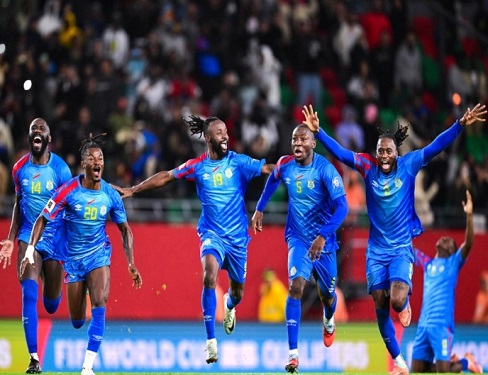
Whether one likes it or not, the French coach is leaving his trademark on the DRC Leopards, the source said. For a country that had waited 52 years simply to return to the World Cup, reaching the knockout stage represented another major milestone.
Pushing England to the limit
Their World Cup campaign ended against England, but not without another demonstration of the competitiveness instilled by Desabre. Brian Cipenga gave the DRC the lead in the seventh minute, and the Leopards held on to that advantage for much of the match. For 75 minutes, England struggled to break through the disciplined defensive block set up by Desabre, before Harry Kane scored twice late in the game to turn the match around and secure a 2-1 victory. The result brought the DRC’s campaign to an end, but their tournament had already rewritten the country’s World Cup history, as part of a long-term project offering valuable lessons for African football.
It is this transformation that makes Desabre’s experience particularly relevant to the CAF Strategic Conference.